Whether your opinion about
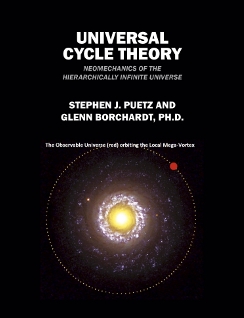
Universal Cycle Theory is positive or negative, please send your feedback. Feel free to post an Amazon review, or send an e-mail to
contact@uct-news.com with your views.
As you read the book, if you find a contradiction, please send it to contact@uct-news.com for our evaluation. Until further notice, we will pay $50 for every valid documented contradiction. Depending on the number of submissions, that price could be higher or lower in the future. Note that a disagreement with conventional theories does not qualify as a contradiction, but the following two items do:
(1) An Observation Contradicts the Theory. If you find a potion of Universal Cycle Theory that contradicts a credible scientific observation, send an e-mail. Give references and details about the observation and how it contradicts Universal Cycle Theory.
(2) An Internal Theoretical Contradiction. If one part of Universal Cycle Theory contradicts another part, send an e-mail. Simply state the Topic Numbers and the Page Numbers of the potential contradictions, and explain why you believe they contradict each other.
Once a potential contradiction is received, it will be posted on this page, and reviewed for its validity. If a contradiction is determined to be valid, you will receive a check in the amount of $50 for each verified contradiction. At his point, no one has found an observational contradiction or an internal contradiction with Universal Cycle Theory. This contrasts with the glaring contradictions among conventional theories. Click in this link for examples of contradictions in standard theories of physics and cosmology: Criticism of Universal Cycle Theory
Potential UCT Contradictions Reported Since November 20, 2011
Entry 1) Submitted on January 12, 2012 by LLH: "If we assume that matter is infinitely divisible and there is no such thing as empty space, then we must accept the logical conclusion that the universe is infinitely filled with matter and therefore contains an infinite amount of matter. However, if we also conclude that material interactions between most forms of matter are limited or nonexistent, then even the presence of an infinite amount of matter cannot give rise to an infinite amount of mass or gravity."
LLH then quoted the items believed to be contradictory. Topic 6.3, paragraph 9 states: "In neomechanics, there is no such thing as empty space." Then, in the next sentence, it states: "Some space and some matter fill every region between any two microcosms." LLH then concluded: "While there is a numerical 'space' between the scales of microcosms, there doesn't have to be any actual space between them."
Next, LLH quoted from Topic 12.5 (Total-Mass), after Eq. 12.5.4, it states: "Likewise, the idea that total-mass approaches infinity for every region of the universe might seem unimaginable. Yet, the assumptions of infinity and interconnection imply exactly that. Think about it. Between any two objects there exist other objects that transmit matter and motion. This type of interconnection continues into infinity." But in Topic 6.9 (Summary), it states: "Remember that infinity is not a number, even though the concept is often used with mathematics and numbers." LLH concluded: "Since it is impossible to approach or reach infinity through any form of addition or multiplication, then envisioning the universe as growing from one microcosm to three, to five, and so one to infinity is an exercise in futility, like the Big Bang. The conception of infinity just is, therefore, the infiniteness of matter and the universe just are."
Responses to Entry 1) Responses to LLH's comments follow, generally dissected one sentence at a time.
Comment 1 from LLH: "If we assume that matter is infinitely divisible and there is no such thing as empty space, then we must accept the logical conclusion that the universe is infinitely filled with matter and therefore contains an infinite amount of matter."
Response to Comment 1: The confusion is between what is real and what is ideal. We use ideal words such as "matter" and "space" knowing that both terms can never be precisely defined in reality. Likewise, using idealized mathematical equations to describe physical realities is also an imperfect process. Unfortunately, while attempting to describe the physical universe, our attempts are often limited to idealized languages and idealized mathematics. That is why we made the statement: "There is no such thing as truly empty space." We wanted to differentiate between the idealization of space used in language, and the infinitely divisible model of space used to make our theories consistent with our assumptions. That is where the confusion lies. Confusing idealized words, idealized math, helpful analogies, and error-prone measurements with reality causes all kinds of false paradoxes. When scientists mistake their mathematical universes on paper with the real universe, it causes a mountain of distorted thinking. They consistently treat their unprovable assumptions as facts -- as well as mistaking the ideal terms and models of their theories with how stuff really works. Universal Cycle Theory does it right by stating assumptions and definitions up-front in the book. Based on our model, the term "space" represents an ideal that may confuse some readers. Some space and some matter separate all forms of matter, but this helpful and idealized explanation only pertains to a specific scale in the infinite hierarchy. In mathematical terms, by defining i as a specific level in the hierarchy, s as the space at that level, and m as the matter at that level, then the following equation neomechanically describes the composition of the space Si at any level in the infinite hierarchy:
Si = ∑Si-1 + ∑mi-1
For example, some portions of space may appear empty from the perspective of the absence of stars. However, atoms fill much of this perceived empty space. Likewise, some portions of space may appear empty from the perspective of the absence of atoms. However, in our model, we presume aether-1 particles fill much of this perceived empty space. This analogy continues into infinity, with aether-2 particles filling the voids of aether-1 particles, with aether-3 particles filling the voids of aether-2 particles, with aether-4 particles filling the voids of aether-3 particles, and so on into infinity. Hopefully, this expanded explanation clarifies our explanation of "space" - which we view as "empty" only from the perspective of the scale under investigation, but which we view as "mostly full" from the perspective of the smaller microcosms that we assume reside between larger microcosms.
Comment 2 from LLH: "While there is a numerical 'space' between the scales of microcosms, there doesn't have to be any actual space between them."
Response to Comment 2: It is unclear what LLH intended to say with this statement, and we were unable to get a clarification. It appears when he wrote actual space he meant ideal empty space, but we really don't know. Of course, we consistently oppose the concept of perfectly empty space in the book. This statement appears to be an interpretation of the universe specific to LLH. The challenge is to find internal contradictions in our theory, which means finding statements in one section of the book that contradict statements in another section. It does not mean finding contradictions between our theories and mainstream theories, or contradictions between our theories and an individual's interpretation of the universe. We already know our theories contradict conventional ideas. That is why we wrote the book. Hence, the preceding statement must be removed as part of the argument because it fails to represent our views. When constructing a challenge, it is best to use exact quotes of our words throughout the statement, while interjecting appropriate transitional phrases such as: then you wrote, then you inferred, then you concluded, etc. Doing so will eliminate any chance of challengers interjecting their own interpretations (or conventional interpretations) into the submission.
Comment 3 from LLH: "If we also conclude that material interactions between most forms of matter are limited or nonexistent…"
Response to Comment 3: Once again, LLH made a statement that fails to conform to the new paradigm that we suggest. We never made such a statement in Universal Cycle Theory. Our assumption of inseparability dictates otherwise. Thus, we assume there is no such thing as a perfectly isolated system. We generally use the neomechanical term "microcosm" to refer to continually evolving matter -- which we state happens to every microcosm in the universe throughout each moment in its life. It is unimaginable that any text in the book came close to stating: "material interactions between most forms of matter are limited or nonexistent." Once again, we are looking for internal contradictions. It is best if a challenger uses exact quotes of our words throughout the statement, while interjecting appropriate transitional phrases between the quotes in the submission.
Comment 4 from LLH: "Even the presence of an infinite amount of matter cannot give rise to infinite amount of mass or gravity."
Response to Comment 4: The preceding text highlights the difficulty of thinking in terms of the new paradigm outlined in Universal Cycle Theory. For example, LLH appears to be thinking about gravitation in terms of the current paradigm - as a thing. In neomechanical theory, amounts, densities, and structures directly apply to matter, whereas distances, paths, and time directly pertain to motions. In our new paradigm, gravitation is a motion - not a thing. The uneven distributions of different forms of matter lead to pressure differences that cause gravitational motions. In meomechanics, gravitation must always be thought of as a motion. Also, I do not recall making the statement that matter is infinite in the book. If any sentence does, then that statement is a mistake. We clearly state that the universe is infinite, and we also state that matter approaches infinity in every region of the universe, but that does not imply, and we never wrote that the amount of matter in the universe is infinite. There is a major difference between infinity and approaching infinity. Once again, the preceding comment by LLH is an incorrect interpretation of the new paradigm outlined in Universal Cycle Theory.
Comment 5 from LLH: "Since it is impossible to approach or reach infinity through any form of addition or multiplication, then envisioning the universe as growing from one microcosm to three, to five, and so one to infinity is an exercise in futility, like the Big Bang."
Response to Comment 5: We agree with LLH that theories cannot be proven, but we disagree that formulating theories is an exercise in futility. Ultimately, the degree of agreement with observations and the presence/absence of internal contradictions lead to favoring one theory over another. That is why we went to great pains to eliminate internal contradictions -- as well as devising a theory that agrees with observations. That is also why we strongly believe that Universal Cycle Theory will be eventually overtake the established trio of theories -- standard particle theory, quantum mechanics, and the Big Bang Theory.
Comment 6 from LLH: "The conception of infinity just is, therefore the infiniteness of matter and the universe just are."
Response to Comment 6: I cannot recall making a similar statement in Universal Cycle Theory, but we do agree with this statement from LLH. However, this statement does not contradict any theory presented in the book.
In summary, it appears that the submission from LLH is based on at least two incorrect views about neomechanics:
(1) that material interactions between most forms of matter are limited or nonexistent, and
(2) that any microcosm (or the universe) has an infinite amount of mass
In neomechanics, every microcosm has a finite life with finite mass - no exceptions. The universe is the sole infinite entity. Equally important, in neomechanics, all microcosms continually interact with surrounding matter (the macrocosm). There is no such thing as a perfectly isolated system in neomechanics. We understand the difficulty of thinking in terms of the new neomechanical paradigm. We occasionally catch ourselves thinking the old ways. Throughout our lives, all of us were trained to think in terms of finite matter, finite time, isolated systems, and motions as things. Now, suddenly abandoning those familiar concepts is difficult for all of us, including ourselves. Yet, with practice and effort, changing your thought patterns to conform to neomechanical standards will eventually become almost automatic.
Our challenge was to find an internal contradiction within our neomechanical theories. Explanations and arguments based on current theories of a finite universe are not part of our theory. Hence, arguments based on conventional ideas are invalid for identifying internal contradictions within Universal Cycle Theory. Any submission for an internal contradiction must be based on the neomechanical paradigm described in the book. Likewise, we also accept submissions for possible contradictions between our theories and established scientific observations. Up to this point, we have not found either type of contradiction, but if we eventually do, we will immediately begin work on modifying our theories.