The Universal Cycle Theory is based on the assumption that the universe is infinite. While this statement might seem uninspiring to many, it holds huge implications about how the universe operates. A finite universe would function differently than an infinite universe. The theory fully explains the expected differences.
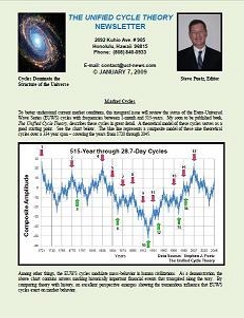
The initial development of infinite universe theory goes back to The Ten Assumptions of Science. [Borchardt, 2004a] In 2007, The Scientific Worldview introduced the concept of Neomechanics, which adapted classical mechanics to conform to the assumption of an infinite universe. [Borchardt, 2007a] Then in early 2009, The Unified Cycle Theory announced the discovery of a seemingly infinite set of cycles, dubbed the EUWS cycles. [Puetz, 2009] The EUWS cycles are now renamed the Universal Wave Series (UWS) cycles. The UWS periods are divisible by a factor of three. For example, dividing the 22.092-gyr UWS cycle by three gives the 7.364-gyr UWS cycle, and dividing that by three gives the 2.455-gyr UWS cycle, and so on.
After becoming aware of the other's work, the co-authors realized they had discovered evidence of an infinite universe from two different perspectives. At that point, curiosity took over, and a great collaborative effort began. The mutual effort led to a merger of their theories and new ideas about how the universe functions. The fruition of these ideas ended with the newly named Universal Cycle Theory: Neomechanics of the Hierarchically Infinite Universe. [Puetz & Borchardt, 2011]
In one sense, the Universal Cycle Theory might seem radical because it postulates that the universe operates in ways that are dramatically different from what we are taught. If the theory is true, then large portions of textbooks, from many sciences, must be rewritten. That certainly is radical. Yet, the theory is conventional in the sense that it closely conforms to virtually all existing laws, equations, and observations. There are only two elements that make the theory radical - cycles and infinity. Other than that, much of the theory is familiar and conventional. The theory primarily focuses on these key elements in the following ways:
Cycles are crucial because they explain how all motion in the universe primarily occurs as a result of two types of cycles - vortices and waves. A vortex causes matter to rotate, which produces circular cycles. Conversely, waves cause matter to compress-and-decompress in repeated oscillations, which produces linear cycles. According to our theory, these two basic motions explain much, if not most, of what happens in the universe.
Infinity is crucial because it explains the extent and structure of the universe. Based on logic and observations, the authors assume that matter is infinitely divisible in the microscopic direction and infinitely integrable in the macroscopic direction. The authors also assume that time was infinite in the past and will be infinite in the future. From the literature, others never used this concept of infinity in previous models of the universe. Hence, the model is unique. The book shows how the new concepts about infinity explain many of the paradoxes and contradictions currently riddling physics and cosmology.
Cycles explain the motions in the universe, infinity explains the hierarchical structure of the universe, and neomechanics explains the scientific laws used in the theory. Think of neomechanics as the same laws used in classical mechanics, but revised to conform to infinity.
The neomechanical worldview offers something that no other theory has to this point - unique insights and perspectives into some of the most challenging dilemmas facing the sciences today. For example, the neomechanical model helped the authors discover the cause of gravitation. More than three centuries ago, Isaac Newton developed an equation for gravitation. However, no one, including Einstein, has ever identified the actual physical cause. The conventional view, of course, is that gravity is a pull; whereas, the Universal Cycle Theory postulates that it is a push.
With repeated collaboration, the authors found the answer that has eluded others since the time of Newton. Gravitation does follow the inverse-square law, just as Newton said; it does involve inertia, just as Einstein and others have said; it does involve a push, just as Lesage and others have said; it does involve vortex motion, just as Descartes and others have said; and it does involve aether, just as many philosophers since the ancient Greeks have said.
Even while agreeing with many aspects of each of these old and much-debated gravitational theories, none of them were adequate. In formulating the new gravitational theory, the authors used neomechanics, took the best from the best, and added a few new ideas. The rest seemed to fall into place with little effort. In the end, they found that gravitation results from pressure from aether - nearly the same as we feel pressure from air. After reading it, you might find the explanation so simple that you could wonder: "Why didn't I think of that myself?"
New theories purporting to explain the universe are quite common. However, supporting those theories with credible evidence is another story. The 618 pages in this book are dedicated to explanations of the logic used in deciphering what must be the physical reason for gravitation. Of course, gravitation is so basic, and its solution formerly so intractable, that one should expect the discovery of its physical cause to impinge on the rest of science. As exciting as it is, this discovery only represents the tip of the iceberg. The authors solved many other puzzles by using the innovative neomechanical approach. The revelations included dark matter, dark energy, dark flow, black-holes, magnetic bonding, molecular bonding, light wave propagation, geomagnetic reversals, volcanic episodes, climatic cycles, mass-extinction cycles, and much, much more. To make a long story short, there is simply too much content to tell you everything in this brief introduction. You must read the book to understand the power of neomechanical reasoning. You will surely be captivated.
The Universal Cycle Theory is based on the premise that the motions of matter are dominated by vortices (rotations) and waves (compressions-decompressions). We observe the repeating motions of vortices and waves as cycles. Some chapters barely mention cycles. There is a good reason for this omission. In the analysis, the word cycle is often insufficient to describe the detail needed to convey the ideas relevant to our theories.
Therefore, the authors use words such as vortex, rotation, wave, compression, decompression, pressure, and gravitation to describe the specific aspects of the cycles of interest. When you read these words, think of cycles and the Universal Cycle Theory. These are the cyclical motions that lead us to conclude that cycles dominate the structure and motions of the universe.
You will find the content thought-provoking and informative. Perhaps the best description of the Universal Cycle Theory is a new worldview about how matter moves in the universe. For example, it explains the cause of gravitation; it predicts when great volcanism (in the form of major flood basalts) will resurface large portions of Earth's surface; it predicts cycles in global climate; and it predicts when the continents will merge again in a giant tectonic collision to form the next supercontinent.
In addition to explaining purely physical interactions and motions, the Universal Cycle Theory demonstrates its extensive reach by overlapping into biological and social sciences. For example, it predicts when life on Earth will encounter episodes of mass-extinctions; it predicts when life will regenerate via mass-evolutionary changes; it predicts the periods when major civilizations will collapse; and it predicts when bouts of financial panic will strike global markets. Why the UWS cycles influence human behavior remains a mystery; however, the correlation between UWS cycles and sociologic and economic behaviors are highly significant. This indicates a likely cause-and-effect relationship.
The Universal Cycle Theory introduces at least six new equations that explain universal motions and make predictions about previously unexplained events. The book gradually presents these equations beginning in Chapter 8 and ending in Appendix A1:
Topic 8.2 gives the atmospheric pressure approximation.
Topic 9.3 gives the updated Titius-Bode rule.
Topic 12.5 gives one of the two premier equations in the book, the total-mass equation.
Topic 15.2 gives the hydrogen-bond equation.
Topic 16.1 gives the equation for calculating UWS periods.
Topic A1.3 gives the other premier equation associated with the Universal Cycle Theory - the general equation for calculating phases of all UWS cycles.
The key difference between the neomechanical model and all previous models of the universe is the firmly-held assumption that the universe is infinite. After embracing the assumption of infinity, the analysis becomes easier, and the universe begins to make sense. Infinity is the key difference that you must always keep in your mind while reading the Universal Cycle Theory.
The new concept derived from the UWS cycles expands on the current concept of waves, which only involves different types of molecular media. The theory postulates than waves propagate through every type of medium, at every level of the infinite universe. These waves appear as cycles in the motions of infinite types of matter. Begin thinking about waves moving through a medium of stars, waves moving through a medium of galaxies, waves moving through a medium of superclusters, waves moving a medium of aether, and waves moving through a medium of any other possible form of matter. Once a person accepts this expanded view of the universe, and then begins applying the known laws of classical mechanics to all levels of the infinite universe, unexplained phenomena suddenly begin making a great deal of sense.
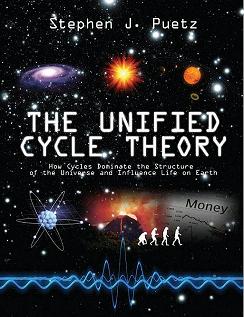
The original version of the theory was published by Outskirts Press in 2009, The Unified Cycle Theory: How Cycles Dominate the Structure of the Universe and Influence Life on Earth. It documents the volumes of evidence supporting the UWS cycles and the other physical cycles.
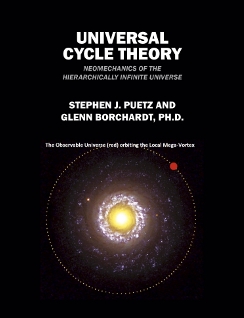
The newest version of the theory was published by Outskirts Press in 2011, Universal Cycle Theory: Neomechanics of the Hierarchically Infinite Universe. It presents a new theory of the universal based on cycles and infinitely divisible matter.